
Business Immigration Programs in Canada

Deprecated: Function get_the_author_ID is deprecated since version 2.8.0! Use get_the_author_meta('ID') instead. in /var/www/sites/lawfirmbackup_200125/wordpress/wp-includes/functions.php on line 6131
Canada offers numerous opportunities for foreign businesses and entrepreneurs to established their business interests in Canada while contributing to the country’s economy. Business Immigration Programs in Canada are available at the federal and provincial levels, each designed for different business needs and desires. This article will provide a general overview of the details an applicant needs to know before applying for any business immigration program.
We will distinguish between some of the available programs and will outline the qualifications for each. Additionally, programs and laws are constantly changing, so it is important to have up-to-date information to assist you with the process. It is therefore advisable to always consult with a lawyer before applying, and our team at Decker, Pex, Levi would be happy to help you with the process.
Initial Considerations
A business immigration program grants the applicant the opportunity to arrive in Canada through a work visa. Many people granted work visas come with family members who have applied for study permits (in the case of children) or open work permits (in the case of spouses/partners). After living in Canada for one to two years on a work permit, you and your family may be eligible to apply for permanent residency.
Before deciding to apply for a business immigration program, you must think about important life decisions you must make; where will you live? Do you speak the necessary languages? Do you have the financial means to support yourself and your family in a new country? Each program has qualifications that applicants must meet.

Cost of a Business Immigration Visa in Canadian Dollars
On April 30, 2024, the Canadian government increased the cost of business visas. As such, a processing fee for an application for any business visa per person will cost well over $2000. If you wish to bring your spouse or partner as well, the processing fee and the right of permanent residence fee will amount to over $1500. Any dependent child brought to Canada through the program will also cost $260. These fees are the bare minimum a person will pay, in addition to any possible legal fees a person may encounter throughout the process.
Overview of the Application Process
Regardless of the business immigration program you choose, there is a general pattern that applicants tend to follow, outlined below in 7 steps:
- You are employed by or have a strong business connection to a Canadian company while working abroad (to be expanded upon below).
- You must demonstrate that you have a plan for the future of your job and business.
- You must show you will be employed by a company in Canada.
- You must apply online through the Canadian government’s application portal.
- When accepted, you will start working in Canada on a work permit.
- After one or two years, you (and your family members) may apply for permanent residency.
- You will eventually be eligible to apply for Canadian citizenship.
Federal Programs That Have Stopped
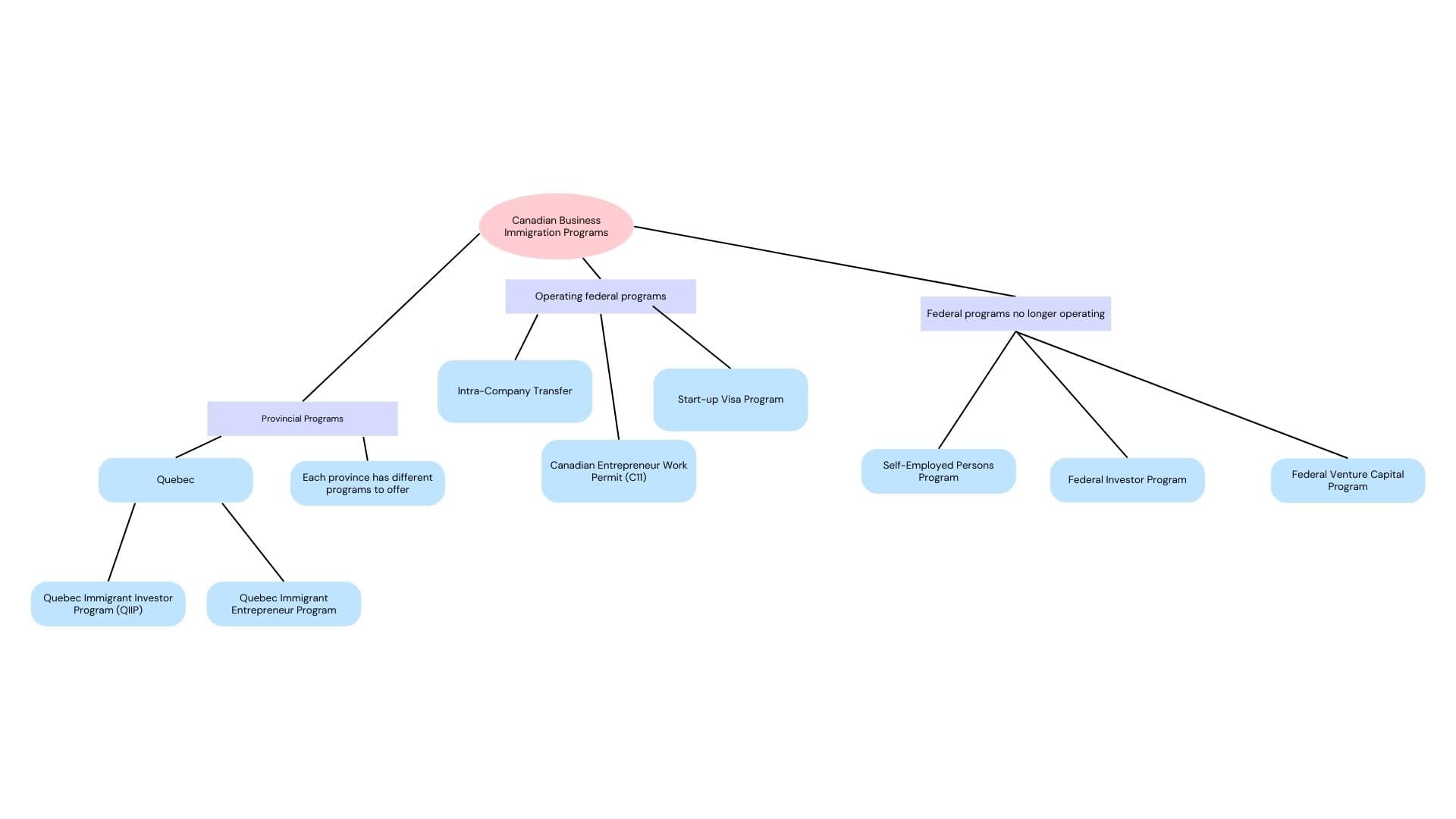
As of 2024, the Canadian government stopped operating the following business immigration programs:
- Self-Employed Persons Program
- Federal investor programs
- Federal venture capital program
- Certain Provincial Business Programs
Federal Programs That Continue to Operate
The three federal programs that continue to operate and will be expanded upon in this article are:
- Startup visa program
- Intra-Company Transfer
- Entrepreneur Visa (C11)
Startup Visa Program
This program is intended for a group of one to five entrepreneurs with a detailed plan for how they wish to expand their businesses in Canada. There are four main qualifications needed before applying:
- The organization of the business must fit the guidelines for the program- Every individual applying from the organization must have the right to vote at least 10 percent of the time, and all applicants and the designated organization combined need to have over half of the total voting rights of the company.
- You must receive a letter affirming investment in the company – This letter must be accompanied by a certificate of commitment sent directly to the Government of Canada.
- You must ensure that you apply early – every year, the government only accepts 10 qualified group applications, reviewed on a first-come, first-serve basis.
- Competence in English or French- Applicants will take a language test showing competence in English or French.
- You must demonstrate that you have the financial means to support yourself (and your family) on the visa once you arrive.
The amount of money you must bring with you to Canada is dependent on the number of family members you are bringing along.
Intra-Company Transfer
For Employees
An Intra-Company transfer (ICT) is a work permit distributed to employees in foreign companies who want to broaden their business interests in Canada. To obtain this permit, a Canadian employer must grant a worker a Labor Market Impact Assessment (LMIA), which affirms the employee’s ability to fill a work position in Canada. There is a list of qualifying factors an employee needs to prove before applying for an ICT:
- The employee has worked for the same company for at least one year within the last three years and intends to work in a similar position in Canada. If an individual has worked part-time, the Ministry of Immigration, Refugees, Citizenship Canada may be more cautious about the employee taking advantage of the visa to obtain a work permit. If the company has undergone a recent merger or acquisition, the employee does not need to have worked for the same company for one year, as long as they have worked with its partner organizations for at least one year in the past three years.
- The job in Canada is temporary.
- The worker must apply to work at an executive level, senior managerial level, or in one requiring specialized knowledge.
An executive-level job is one in which a person:
- Creates a list of goals they would like to execute while overseeing functional elements of the company.
- Has the ability to make decisions based on their discretion.
- Reports to a small group of higher authorities.
A managerial level job is one in which a person:
- Has the authority to make important decisions about the company at their discretion while supervising the work of others and managing a company.
Specialized Knowledge means that a person has expertise in a unique field. According to NAFTA, someone with Specialized Knowledge must have Proprietary Knowledge and Advanced Expertise. Proprietary Knowledge is knowledge in a field that remains private to a company. Advanced Expertise is knowledge a person has obtained from years of experience, contributing to the company’s success.
For Companies
ICTs can be useful for startup companies wishing to expand their businesses in Canada. However, to qualify for this permit, a company must have a relationship with an existing company in Canada, either as an additional branch, affiliate, or parent. These organizations must be constantly engaged in business with one another. The business in a foreign country must demonstrate that it can financially uphold the costs of a startup in another country, and has detailed plans for executing its business. Companies must prove that they will constantly be monitoring their employees in Canada and the progress that they have made on the job.
Canadian Entrepreneur Work Permit (C11)
The C11 work permit allows self-employed workers, entrepreneurs, and startup founders to work in Canada. Once an employee arrives in Canada under this visa, after one to two years they can apply for permanent residency. This visa also allows employees and their family members to immigrate, and receive study and open work permits. To apply for this permit, an employee must demonstrate significant planning in their business with the necessary financial means to carry out their plan. They must also demonstrate the experience they have, and how it will contribute to the Canadian economy.
Provincial Entrepreneur Programs
Many provinces in Canada offer various business visa opportunities available for qualified applicants. The application process and requirements will be different in each province. It is important to monitor which programs are being updated.
Quebec
Based on the Canada-Quebec Accord, Quebec has a framework separate from the federal government to establish investor and entrepreneur immigration opportunities in Canada. One such program is the Quebec Immigrant Investor Program (QIIP), the only investor program offered in Canada. This program was established to improve the Quebec economy, providing opportunities for investors to engage in business in Quebec. To apply for this program, you must:
- Demonstrate proficiency in French
- Have a net worth of at least 2 million Canadian dollars
- Invest 1.2 million dollars into a government-guaranteed investment for a minimum of 5 years
- Plan on living in Quebec after moving
- Have graduated high school
- Have experience with business management
Additionally, the Quebec Immigrant Entrepreneur Program has two options for entrepreneurs who intend on moving to Quebec, and who must have a net worth of 300,000 Canadian dollars before applying.
Concluding Remarks
There are numerous ways to Canada through a business immigration program, but things are always changing and regardless of which stream you apply through, it will be competitive. For these reasons, it is always best to get legal help before proceeding, to avoid complications. At Decker, Pex, Levi , we specialize in immigration to Canada and have years of professional experience.

 :
: :
:מאמרים מומלצים